

methodology

kMatrix Sector Methodology

The kMatrix research methodology started as an international research programme within Harvard University and was subsequently developed in countries across Europe. The core research processes within the methodology are used to track technology and market change and employs “big data”, analytical industrial data grids, business case studies and industry-level research to provide probabilistic and measurable evidence about how companies and economies adapt to and perform within changing market conditions. 

Evidence-based Industry Data.
165
Countries and Territories Measured
5,323
Basic Business Models
5,259
Technologies Profiled
4,568,0
Case Studies

We Transform Your Vision into Creative Results

The fundamental concept of the process is to use triangulation, similar to that used by satellites for navigation, to look at, in and around a sector, using robust and recognised data sources, including unusual sources such as recruitment and investment information (some in the public domain, some not) which are then used to calculate new values for sales, exports, number of companies, employees and over 65 other metrics. This process is described and demonstrated in detailed methodology documents for various sectors including security, low carbon, green economy, digital media, construction, healthcare, climate services etc. and, despite the innovative nature of the methodology, was awarded UK statistical status in 2013. Analysts from Greater London Authority have assessed the process and data and approve its use. 


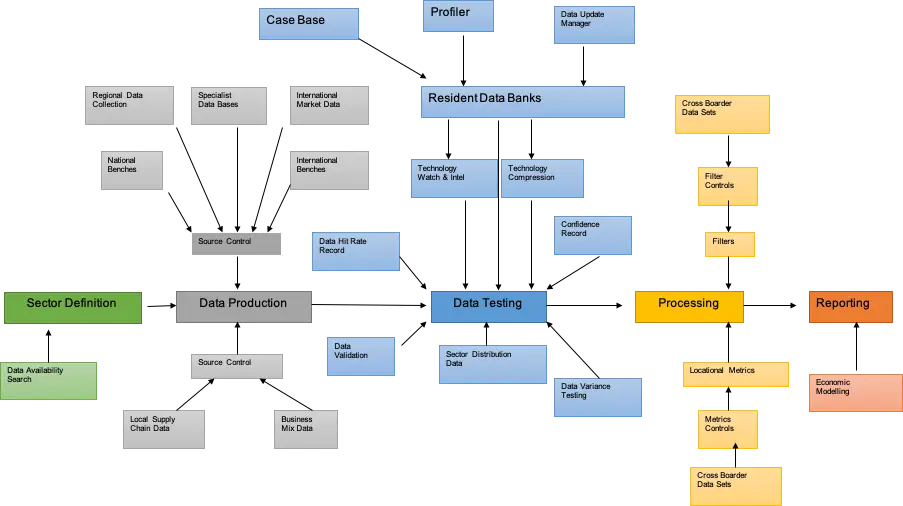
The flow chart in figure 1 gives an outline of the kMatrix profiling system, the same basic process is used, with slight variance depending on whether it is a full sector being mapped, or a single technology being mapped through a supply chain.  Some sectors are easier to map than others, for example, Climate Services is an emerging sector, albeit using existing competencies, which is difficult to measure, with sparse data sources available.  In contrast, construction is a well-established sector, with a wide range of high quality and robust data sources.  Sources selected varies, with never less than 7 sources used per data value.

 

Brian McCann-Clarehill Plastics
"It was amazing, the industry had no coherent or consistent information on the installed base of single skinned oil tanks or the environmental threat they represented. kMatrix and their multi- sourced approach produced new information -for the past 20 years!- that was robust enough to inform my own business strategy and to take to government and suggest an environmental policy change."
previous arrow
next arrow

This multi-source research methodology is most often employed within the public or private sector when:

This multi-source research methodology is most often employed within the public or private sector when:


  • An emerging or newly “discovered” sector needs to be defined and quantified
  • An existing sector needs a more flexible and detailed segmentation than SIC can provide
  • International market information and national comparative datasets are required

In these circumstances the methodology provides:


  • Internally consistent global research, based upon market intelligence sources and rules rather than national statistics, that can be used to measure economic sectors that are not well represented by Standard Industrial Classification (SIC) codes or industry bodies
  • Flexible/adaptable data structure with multiple levels of detail and multiple measures for benchmarking competitiveness and identifying international markets and market opportunities.

The methodology reflects best practice in private sector research processes like market research, competitive and competitor intelligence gathering and analysis – as well as more traditional public sector economic assessment methodologies. It has developed from long term experience of selecting, monitoring, evaluating, triangulating and then analysing multiple unstructured, semi-structured and structured data sources to produce quantified values, forecasts and economic/industrial indicators with explicitly measured levels of data confidence.

kMatrix methodology – Brief Model